
Engaging Introductions: Capturing Your Audience’s Interest
In today’s industrial automation environment, Human Machine Interface (HMI) systems have become an essential part of almost every manufacturing facility. Whether it is a textile plant, pharmaceutical company, food processing unit, packaging machine, power plant, automobile industry, or chemical factory, HMIs provide the interface between operators and machines. Through an HMI, operators can monitor machine status, adjust process parameters, receive alarms, view production data, and control equipment efficiently. When an HMI stops working, production can slow down or even come to a complete halt, resulting in costly downtime and reduced productivity.
Industrial HMIs often operate continuously in harsh environments where they are exposed to dust, heat, vibration, humidity, voltage fluctuations, and electrical noise. Over time, these conditions can damage sensitive electronic components, resulting in display problems, touch failures, communication errors, or complete power failure. Many industries assume that a faulty HMI must be replaced, but in reality, a large percentage of failures are repairable through professional electronic troubleshooting and component replacement.
One of the most common problems we receive is a completely dead HMI that does not power on. This type of failure is often caused by damaged power supply circuits, short circuits, failed voltage regulators, burnt protection components, or defective power management ICs. Our engineers carefully inspect the PCB using professional diagnostic equipment to identify the exact fault before replacing only the damaged components. This component-level approach allows us to restore many HMIs that would otherwise be considered beyond repair.
Another frequently reported issue is a blank or white display. In some cases, the HMI powers on normally, but the screen remains black, white, or shows only partial graphics. Such problems may be caused by LCD driver failures, damaged display connectors, backlight circuit issues, or faulty display control ICs. Instead of replacing the complete display assembly whenever possible, our engineers troubleshoot the electronic circuitry to identify the root cause and perform precise repairs, helping customers save both time and money.
Touchscreen-related faults are equally common in industrial environments. Operators may experience delayed touch response, inaccurate touch positions, or complete touchscreen failure. These issues can arise due to damaged touch controllers, worn touch panels, broken ribbon connectors, or calibration failures. Our repair process includes detailed testing of both the display and touch interface to ensure smooth and accurate operation before the unit is returned to the customer.
Communication failures are another major reason for HMI malfunction. Modern HMIs communicate continuously with PLCs, VFDs, servo drives, CNC systems, and industrial controllers through communication protocols such as RS232, RS485, Ethernet, Modbus, CAN Bus, and Profibus. Damage to communication circuits can prevent the HMI from exchanging data with the machine, causing alarms, production interruptions, or complete system shutdown. At Soham Technologies, we diagnose communication-related faults at the PCB level and repair damaged interface circuits to restore reliable communication with connected equipment.
Many HMIs also suffer from software-related symptoms such as boot loops, startup freezes, firmware corruption, or continuous restarting. Although these problems often appear to be software issues, they may actually be caused by unstable power supplies, faulty flash memory, damaged EEPROMs, or processor-related faults. Our engineers combine electronic diagnostics with firmware verification to determine the actual cause before performing the necessary repairs, ensuring the HMI operates reliably after servicing.
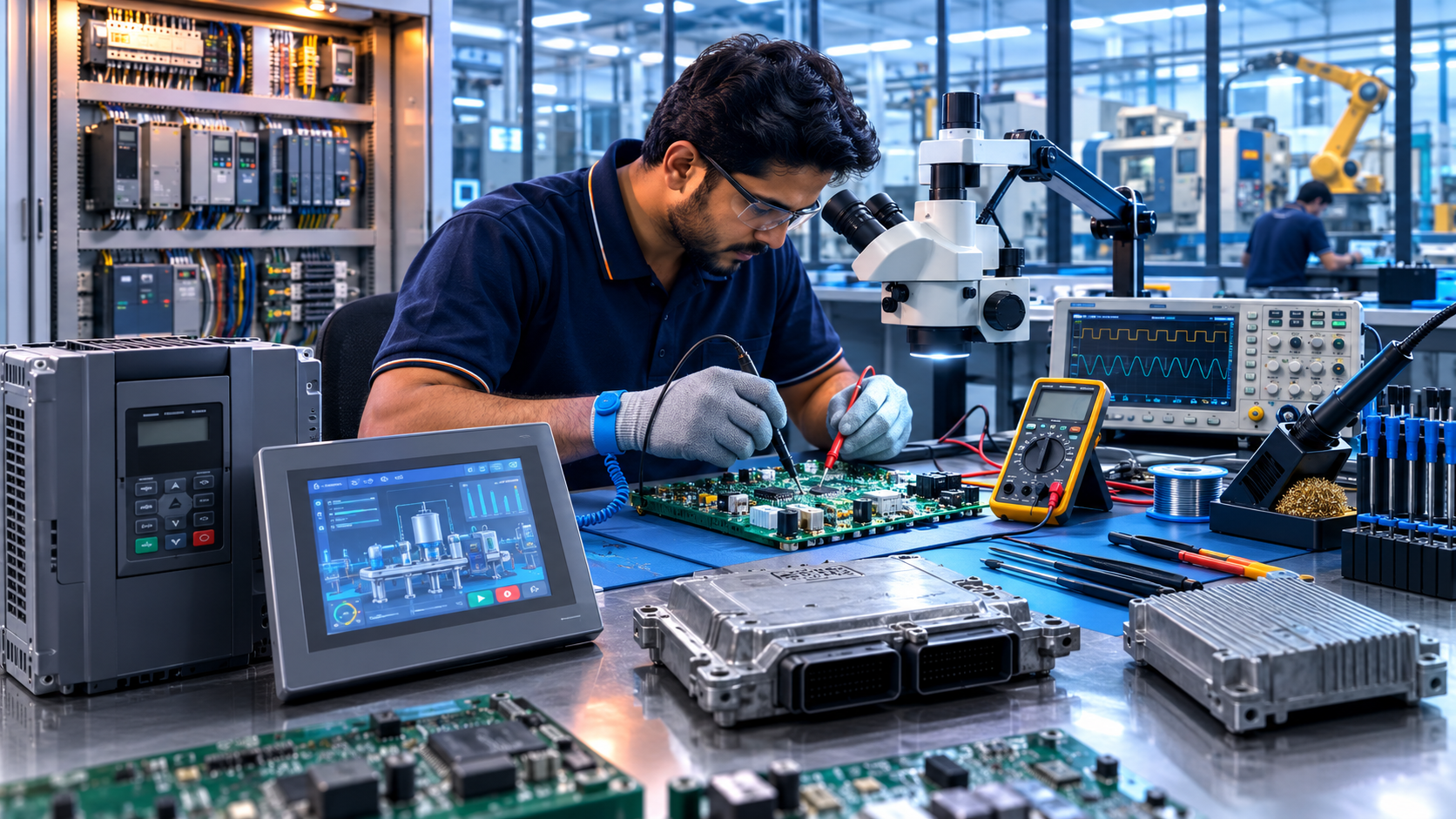
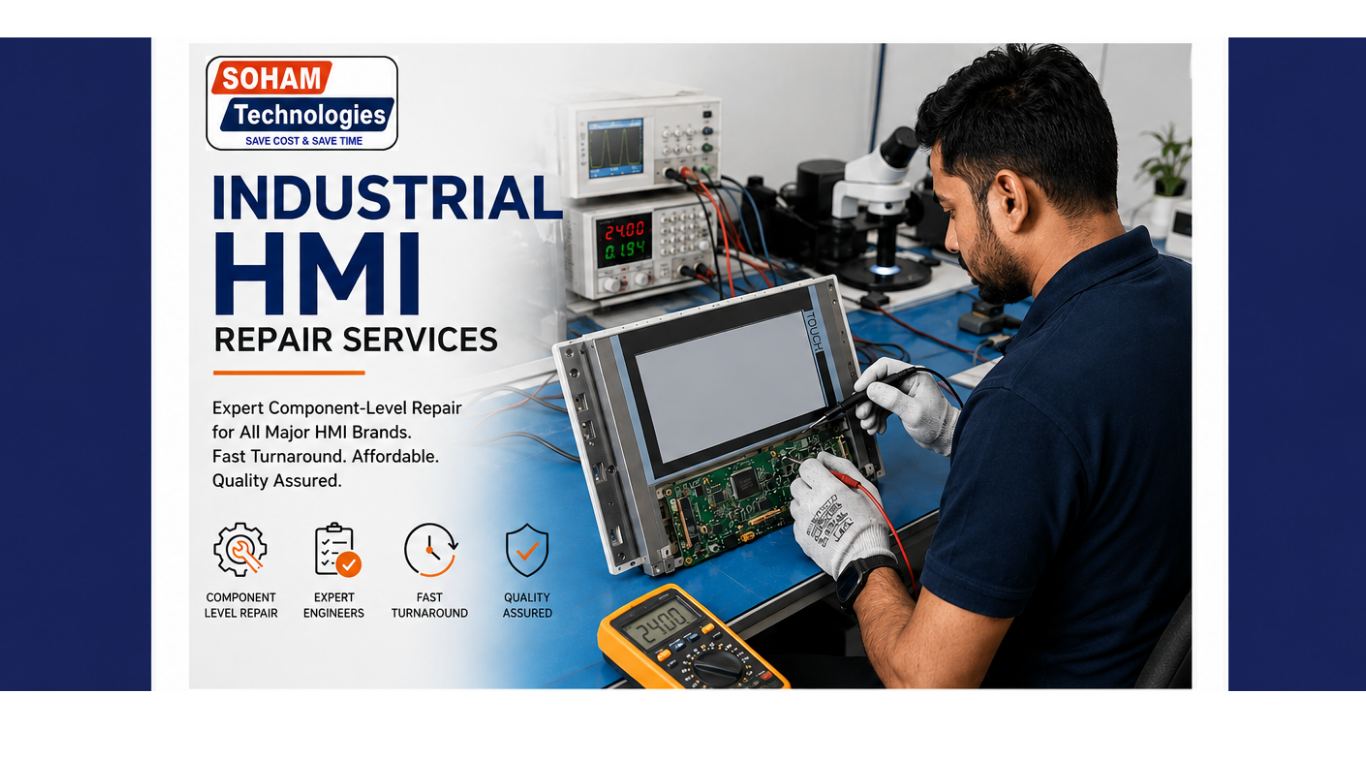
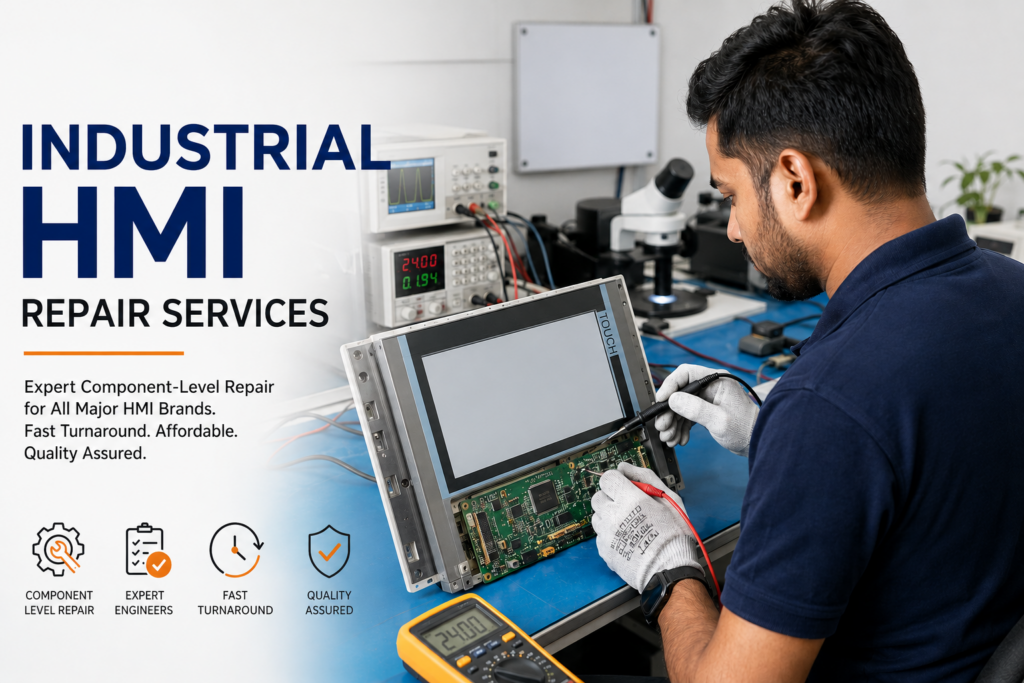
Every HMI that arrives at Soham Technologies undergoes a structured repair process. The unit is first visually inspected for signs of physical damage, moisture ingress, overheating, burnt components, or damaged connectors. It is then analyzed using advanced diagnostic instruments such as oscilloscopes, digital multimeters, thermal imaging cameras, microscopes, logic analyzers, and regulated power supplies. Once the faulty section has been identified, only the defective electronic components are replaced using professional soldering and rework equipment. After repair, the HMI undergoes extensive functional testing, display verification, touchscreen calibration, communication testing, and burn-in testing to ensure stable performance under industrial operating conditions.
Our engineers repair HMIs from leading industrial automation manufacturers including Siemens, Mitsubishi Electric, Pro-face, Allen-Bradley, Omron, Schneider Electric, Delta, Weintek, Fuji Electric, ABB, B&R Automation, Beckhoff, Panasonic, Unitronics, Red Lion, Maple Systems, Kinco, Hitachi, Toshiba, Bosch Rexroth, Emerson, Yaskawa, Eaton, GE Fanuc, and many other international brands. Whether the HMI is installed in a CNC machine, packaging line, injection molding machine, textile machine, printing press, pharmaceutical equipment, power plant, or heavy industrial machinery, our team has the expertise to diagnose and repair complex electronic failures.
Choosing repair instead of replacement offers significant advantages for industries. New HMI panels are often expensive, and discontinued models may have long procurement lead times or may no longer be available. Component-level repair not only reduces maintenance costs but also minimizes production downtime and extends the service life of existing equipment. Since the original HMI remains with the machine, there is often no need for software modifications or mechanical changes, making repair a faster and more practical solution.
At Soham Technologies, our goal is to provide reliable, cost-effective, and technically advanced industrial electronics repair services that help industries keep their production running without unnecessary replacement expenses. Our commitment to quality workmanship, thorough testing, and customer satisfaction has made us a trusted name in industrial HMI repair services. If your HMI is experiencing display issues, touchscreen problems, communication failures, power faults, or any other electronic malfunction, our experienced team is ready to provide professional component-level repair solutions that restore your equipment to reliable working condition.