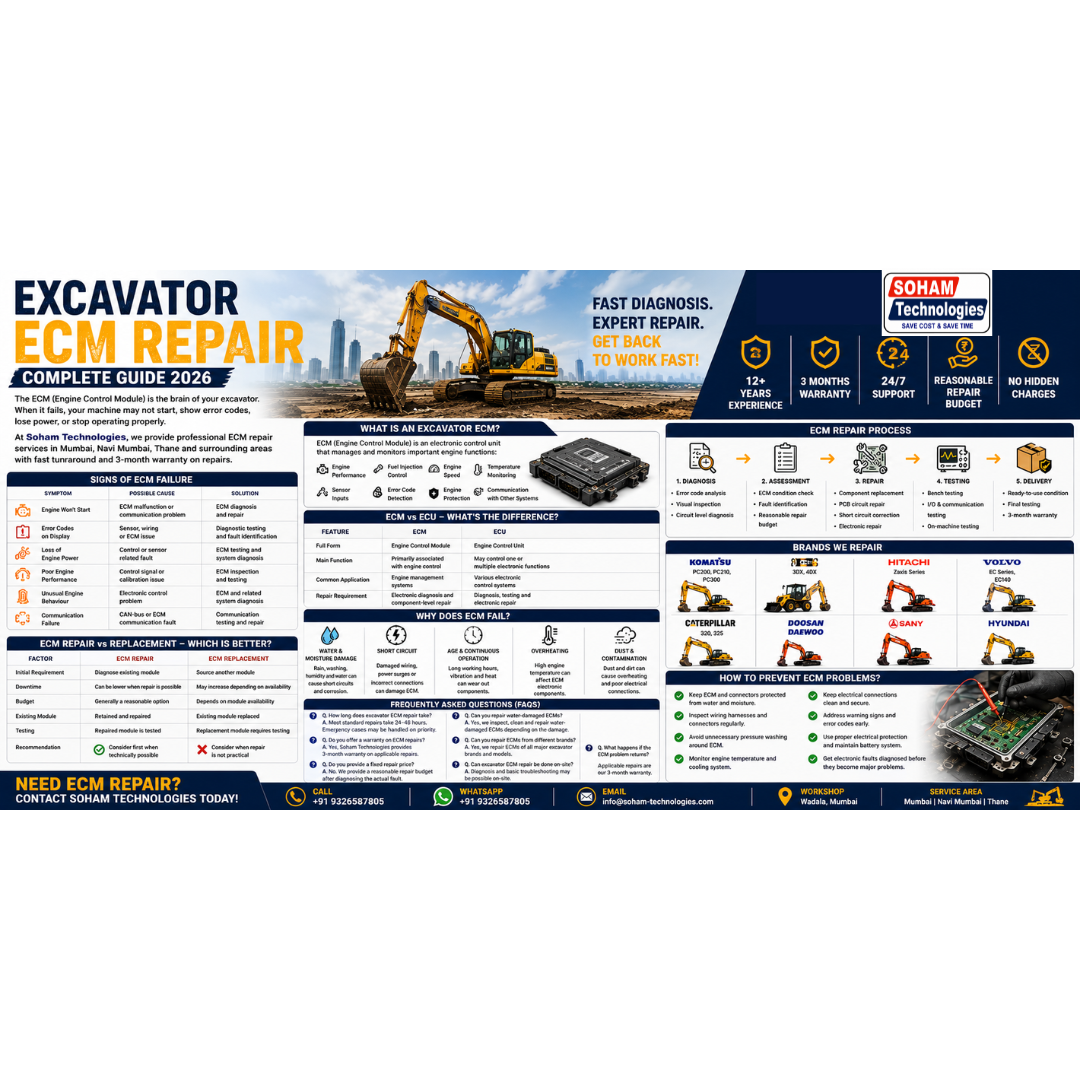


Modern excavators have become highly advanced machines that rely on sophisticated electronic control systems to deliver power, efficiency, safety, and productivity. Unlike older mechanical excavators, today’s equipment continuously exchanges information between dozens of sensors and multiple electronic control units to maintain smooth engine performance under changing operating conditions. At the centre of this intelligent system is the Engine Control Module (ECM), a powerful electronic controller responsible for managing every critical aspect of engine operation.

When the ECM functions correctly, operators rarely notice its presence because every adjustment happens automatically. Fuel injection timing, engine speed, turbocharger control, emissions management, coolant monitoring, sensor communication, and hydraulic coordination are all handled by the controller within milliseconds. However, when an ECM develops an internal fault or loses communication with other systems, the excavator may suddenly begin showing warning lights, fault codes, abnormal engine behaviour, or complete shutdown.
For many operators and fleet owners, these electronic failures appear without warning. A machine that performed perfectly the previous evening may refuse to start the next morning. Another excavator may continue operating but suddenly lose power whenever it is placed under heavy load. Some machines display multiple diagnostic fault codes even though no obvious mechanical problem is visible. Because electronic failures can mimic fuel system problems, injector faults, hydraulic issues, or sensor failures, accurate diagnosis is essential before replacing expensive components.
Unfortunately, one of the biggest mistakes made in the field is replacing the Engine Control Module without proper testing. In many situations, the ECM itself is not the root cause of the problem. Damaged wiring harnesses, poor battery voltage, corroded connectors, failed sensors, water ingress, alternator faults, or communication issues on the CAN Bus network may all produce symptoms that appear to indicate a defective controller. Replacing the ECM without identifying the actual cause often results in unnecessary expenditure while the original problem remains unresolved.
At Soham Technologies, we specialise in professional component-level Excavator ECM repair for heavy construction equipment. Our engineering team follows a systematic diagnostic approach that identifies the true cause of electronic failures before recommending repair or replacement. By repairing electronic components at board level wherever possible, we help contractors, equipment owners, mining companies, and infrastructure developers reduce maintenance costs while restoring machine reliability.
In this guide, we will examine the most common Excavator ECM problems, explain why they occur, discuss how professional diagnostics are performed, and explore why component-level repair is often a practical alternative to replacing the complete controller.
Why Excavator ECM Problems Should Never Be Ignored
Electronic problems rarely disappear on their own. In many cases, the first warning signs are intermittent. An operator may notice that the engine occasionally hesitates during acceleration, the throttle response feels slower than usual, or warning indicators briefly appear before disappearing. Because the excavator continues operating, these symptoms are often ignored until a complete breakdown occurs.
As electronic damage progresses, the machine may begin storing diagnostic trouble codes in memory. Communication between controllers can become unstable, sensors may report inconsistent values, and the ECM may enter protective operating modes designed to prevent further engine damage. Although these safety functions help protect expensive engine components, they also reduce machine productivity by limiting engine speed and hydraulic performance.
Eventually, the controller may lose communication completely or suffer an internal power supply failure, causing the excavator to stop unexpectedly. On an active construction project, even a few hours of downtime can affect excavation schedules, labour utilisation, material deliveries, and project completion deadlines. Early diagnosis and professional repair therefore play an important role in reducing operating costs and preventing more extensive electronic damage.
Most Common Symptoms of a Failing Excavator ECM
One of the challenges in diagnosing ECM-related problems is that no single symptom confirms controller failure. Instead, technicians evaluate multiple operating conditions together while analysing fault codes, sensor readings, communication signals, and electrical measurements. The following symptoms frequently indicate that the Engine Control Module or its supporting electronic systems require professional inspection.
Excavator Does Not Start
Perhaps the most obvious symptom is an excavator that refuses to start even though the battery, starter motor, and fuel supply appear normal. In this situation, the ECM may not be receiving power correctly, may have internal circuit damage, or may be unable to communicate with critical engine sensors. Without proper electronic control, fuel injection cannot be managed accurately, preventing the engine from starting.
Engine Starts but Stops Unexpectedly
Another common complaint is an engine that starts normally but shuts down after a few seconds or while operating under load. This behaviour often results from unstable power supply circuits, damaged communication drivers, overheating electronic components, or protective shutdown strategies initiated by the ECM after detecting abnormal operating conditions.
Loss of Engine Power
Operators frequently report that the excavator feels unusually weak during digging operations. Engine speed may fluctuate, acceleration becomes sluggish, and hydraulic performance is noticeably reduced. Although these symptoms can be caused by mechanical issues, ECM communication problems or incorrect sensor processing may also reduce available engine power.
Excessive Fuel Consumption
A damaged Engine Control Module may process incorrect sensor information, causing inefficient fuel injection timing or improper air-fuel ratio calculations. Even if the excavator continues operating, fuel consumption may increase significantly, affecting operating costs over time.
Warning Lights and Fault Codes
Modern excavators constantly monitor electronic systems. Whenever abnormal operating conditions are detected, warning indicators appear on the operator display and diagnostic trouble codes are stored in memory. These fault codes provide valuable information but should never be interpreted in isolation. Professional technicians always confirm electrical measurements before replacing components based solely on stored codes.